Choose the Slope, Not the Title: Why How Fast You Learn Beats Where You Start
By Jawad Chafai, RevOps and GTM engineer ·
The learning slope idea, explained: why a steep learning curve beats a big head start, what the research says about non-routine work, J-curve careers, and how to judge a job by its slope.
I did not start in tech.
No computer science degree, no engineering title, no famous company on my CV. I studied communication and media, and my first jobs were about people: running learner communities, onboarding, retention calls, events.
Two years later, I run the revenue systems a B2B sales team works in. Salesforce, enrichment, automation, pipeline reporting.
That is not a story about talent. It is a story about one idea I wish someone had drawn for me earlier: the slope.
The line that changed how I think about careers
In a 2012 lecture at Stanford, the computer science professor John Ousterhout paused his operating systems class to give students a "thought for the weekend". It was one sentence:
A little bit of slope makes up for a lot of y-intercept.
If you remember school maths, the y-intercept is where a line starts. The slope is how fast it climbs. Two lines: one starts high and climbs slowly, the other starts low and climbs fast. Wait long enough and the steep one always crosses the flat one. Always.
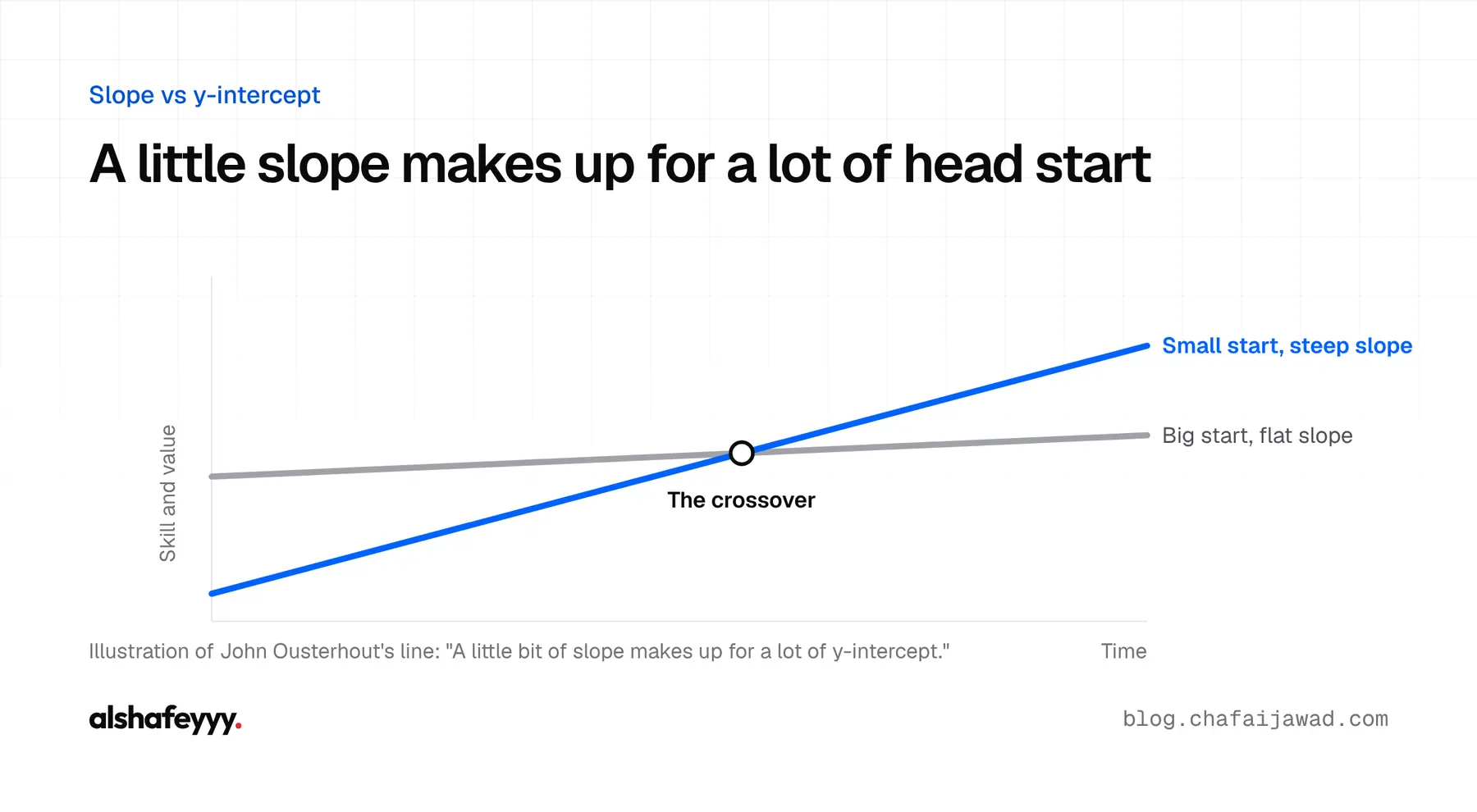
In a career, the y-intercept is everything you arrive with: your degree, your school, your first title, your network. The slope is how fast you learn once you are inside.
We obsess over the intercept. We compare titles on LinkedIn, we chase the brand-name first job, we feel behind because someone our age has a bigger number next to "Manager". And we almost never ask the only question that compounds: how fast will I learn here?
What a steep slope actually looks like
Slope is not a motivational poster. It shows up in the data.
The Harvard economist David Deming has spent years studying how wages grow over a working life. In one paper, he shows that the US college wage premium more than doubles across a career, from 27% at age 25 to 60% at age 55, and that most of that growth happens within jobs, not by switching between them. The kind of job you sort into early decides how steep the rest of the curve is.
The pattern is sharpest when you compare routine and non-routine work. In routine occupations, he finds almost no wage growth after the first few years of tenure. In another paper, wage growth after age 35 is roughly twice as fast in decision-intensive occupations as in others.
Read that slowly. Routine work flattens. Work that makes you decide, design, persuade and solve messy problems keeps climbing.
That matches what I see every day. The most valuable part of my work is not clicking through Salesforce. It is the judgment around it: which field should exist, which lead should go to which rep, what to automate and what to leave human. Nobody can hand you that in a training. You get it by being thrown at problems nobody has solved for you yet.
Stairs or J-curves
On Lenny's Podcast, the operator Molly Graham told the story of how Chamath Palihapitiya, then at Facebook, convinced her to take a job she was not qualified for. He drew two shapes on a whiteboard.
The first is stairs: a promotion every couple of years, a slightly bigger title, a slightly bigger salary. Predictable. Comfortable.
The second is a J-curve: you jump into something too big for you, you dip because you are out of your depth, and then you climb, fast, far above where the stairs would have taken you.
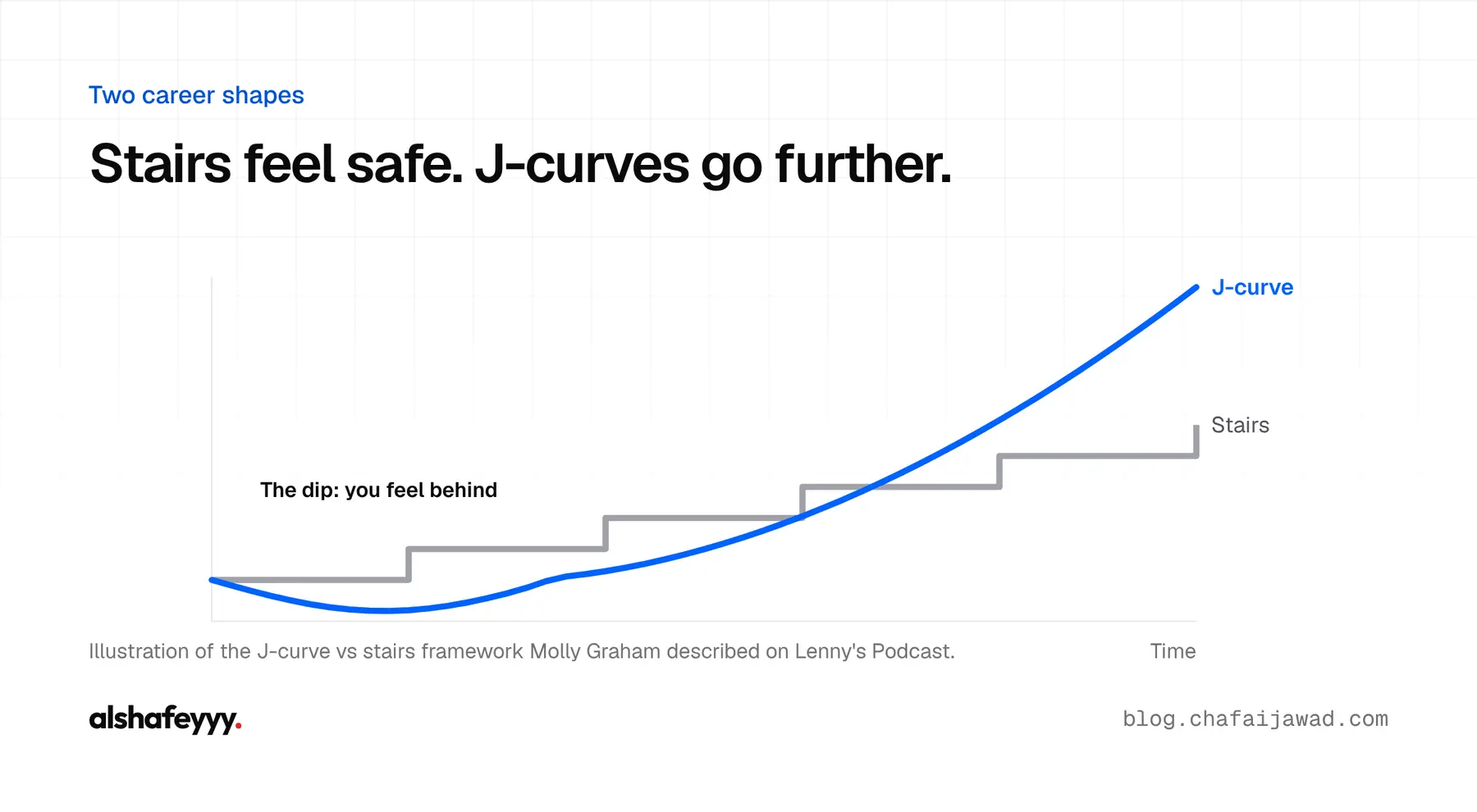
The dip is the part nobody puts on LinkedIn. It is the months where you feel slow, where everyone around you seems to know more, where you wonder if you made a mistake. It is also exactly where the slope is steepest.
The ladder was always a myth anyway
The ladder metaphor assumes careers go straight up. Most do not.
Years ago, the Fortune editor Pattie Sellers suggested a better image, which Sheryl Sandberg later made famous in Lean In: a career is a jungle gym, not a ladder. On a ladder you can only go up or down. On a jungle gym you move sideways, sometimes down, to reach a higher bar you could not reach from where you were.
A lateral move that teaches you a new skill is not a step back. It is a change of slope.
My slope, so far
Here is my own line, honestly.
2024: people. Three internships across entrepreneurship, retention and community. I learned why people drop out of a process: not because they are lazy, but because the process does not fit their life. Cohort completion went up 14% that year.
2025: operations. I ran campaigns for more than 1,100 learners, then moved into hub operations, where the tools did not exist. So I built them: a membership and check-in system on Salesforce, which meant learning data models, flows and reporting from zero. Two Salesforce certifications came out of that, Administrator and Associate.
2026: revenue. Today I own the revenue stack for a six-person outbound team: the CRM, the data, the sequencing and the reporting. On the side, I founded the CMX community chapter in Morocco and grew it to 60 members.
None of those moves were promotions on a ladder. Several of them were sideways. Every one of them started with a dip where I felt like the least qualified person in the room.
That is the point. My y-intercept was low for this field. My only real advantage was choosing, again and again, the job where I would learn the most.
How to read the slope of a job before you take it
A job description tells you the intercept: title, salary, company logo. You have to dig for the slope. These are the questions I use:
- Will I be given problems nobody has solved yet? If every task has a documented answer, the slope is flat.
- How close am I to the core of the business? Revenue, product and customers teach faster than side projects.
- Who will I learn from? One person a level or two above you, who explains their thinking, is worth more than a famous logo.
- How fast do I get feedback? Weeks, not quarters. Fast feedback is what turns effort into learning.
- Will I be slightly out of my depth? If you already know how to do everything in the job description, you are buying comfort, not growth.
- What will I be able to do in a year that I cannot do today? If the honest answer is "the same things, faster", keep looking.
When a flat slope is the right call
To be fair: slope is not everything, all the time.
Sometimes you need stability. A family, a visa, a debt, a health problem. A predictable job that pays the bills is a perfectly good choice for a season, and nobody should feel guilty for taking stairs when stairs are what life requires.
And a steep slope in the wrong direction is still the wrong direction. Learning fast only compounds if the skills you are stacking point somewhere you actually want to go.
But if you are early in your career, the maths is on your side. You have the longest runway to let a steep line overtake a high one. Spend it on slope.
Pick the job that makes you a little uncomfortable every Monday. That discomfort is the slope.
Jawad
References
- John Ousterhout, CS140 lecture, Stanford, January 2012, via Sketchplanations
- David Deming, Why Do Wages Grow Faster for Educated Workers?, NBER Working Paper 31373
- David Deming, The Growing Importance of Decision-Making on the Job
- Lenny Rachitsky, The best careers look like J-curves, not stairs
- Contraminds, Choose your job by its learning slope
- Pattie Sellers, Why you should think of your career as a jungle gym, not a ladder
If you are moving into RevOps or GTM work from another field, I wrote about what a GTM engineer actually does and the systems I build.