GTM Engineer vs RevOps: What the Role Really Is in 2026 (and How to Become One)
By Jawad Chafai, RevOps and GTM engineer ·
What a GTM engineer actually does, how the role differs from RevOps, the skills and tools job postings ask for in 2026, and a practical path into the role.
"GTM engineer" is one of the fastest-growing titles in B2B sales, and also one of the most argued about. Is it a new job, or RevOps with a new name? I work on both sides of that line: I run revenue operations for a B2B outbound team and build the automations that feed its pipeline. Here is what the role actually is, what hiring teams ask for, and how to get into it.
What is a GTM engineer?
A GTM (go-to-market) engineer is a technical operator who turns a sales or marketing process into a working system. Instead of asking reps to research accounts by hand, they build a pipeline that pulls target companies from a data source, enriches them, scores them against the ideal customer profile and hands reps a ready-to-call list.
The work sits between sales, marketing and data. Typical projects include:
- Enrichment and lead scoring pipelines
- Signal-based outbound: reaching out when a company hires, raises money or changes tools
- AI agents that research accounts and draft personalised openers
- The glue between the CRM, data providers and sequencing tools
GTM engineer vs RevOps: the real difference
The simplest way to separate the two is build versus govern. A GTM engineer asks what can we build that does not exist yet? RevOps asks is the engine we have accurate, predictable and clean?
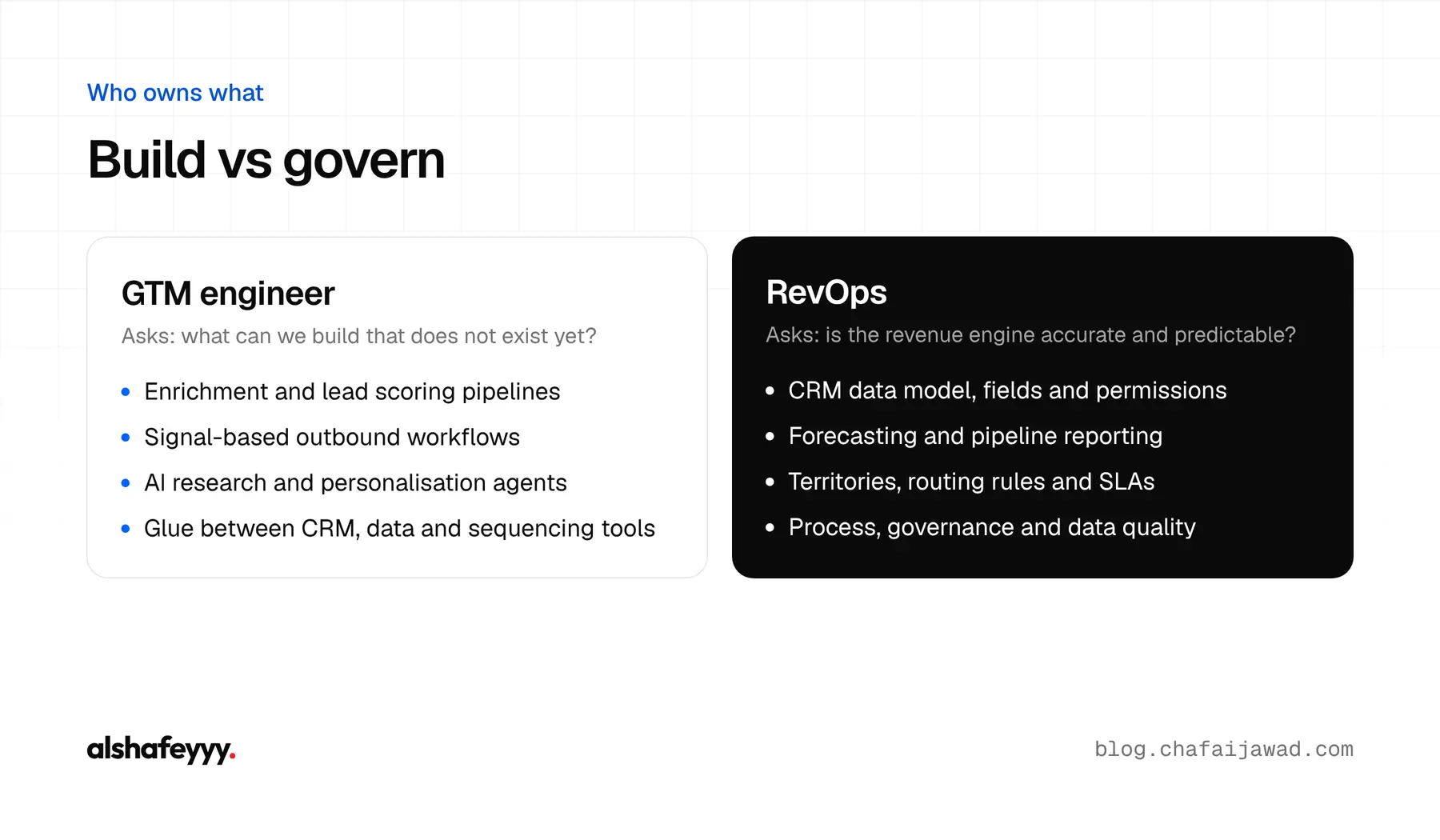
On paper, the overlap is large. Bloomberry's analysis of over 1,000 job postings found that 9 out of 10 responsibilities listed in GTM engineer roles also appear in RevOps engineer postings. The difference is emphasis: RevOps roles call out forecast accuracy far more often (76% of the RevOps postings in that study), while GTM engineer roles lean toward outbound and prospecting.
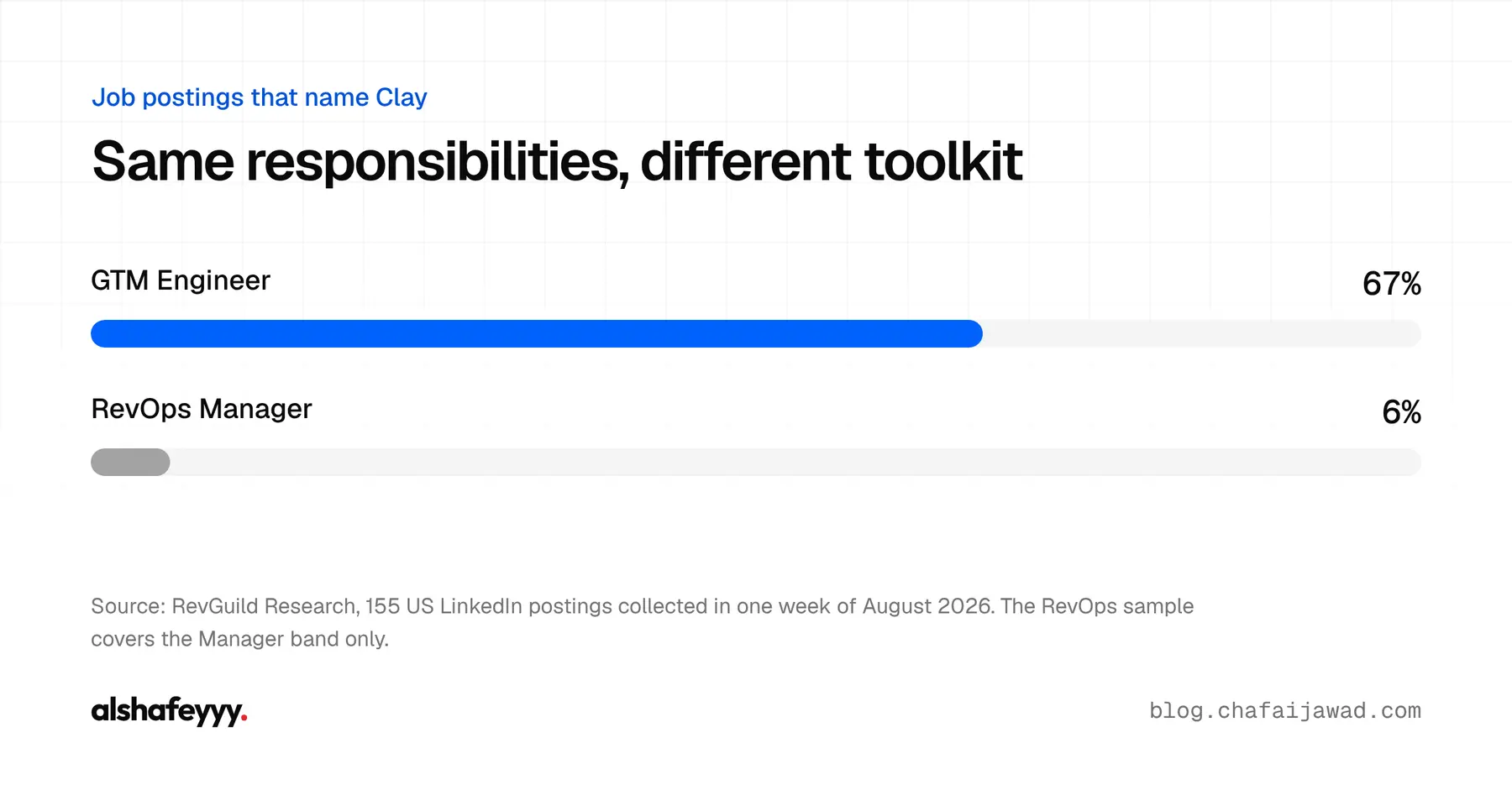
The toolkit is where the roles split. In RevGuild's August 2026 study of 155 US LinkedIn postings, Clay was named in 67% of GTM engineer postings and only 6% of RevOps manager postings.
| GTM engineer | RevOps | |
|---|---|---|
| Main question | What can we automate or build next? | Is our revenue data and process right? |
| Owns | Enrichment, scoring, outbound workflows, AI agents | CRM data model, forecasting, routing, reporting |
| Measured on | Pipeline created, speed, cost per lead | Forecast accuracy, data quality, adoption |
| Typical tools | Clay, Apollo, n8n or Make, APIs, LLMs | Salesforce or HubSpot, BI tools, spreadsheets |
The skills and tools hiring teams ask for
Across postings, the same building blocks come up again and again:
- A CRM, deeply. Salesforce or HubSpot. You need to understand objects, fields and how data flows between them, because every pipeline you build ends in the CRM.
- An enrichment and data tool. Clay is the most named, followed by providers like Apollo.
- A workflow tool. n8n, Make or Zapier to chain steps together on a schedule or a trigger.
- APIs and webhooks. Most useful systems connect two tools that were never designed to talk to each other.
- AI and LLMs. Prompts written as business rules: score this account, summarise this website, draft this opener.
- Some code, sometimes. Bloomberry found SQL and Python each named in 38% of GTM engineer postings. Useful, not universal.
What the work looks like: a real example
One of the systems I built is a B2B prospecting pipeline. The problem was simple: reps were spending days researching companies before they could pick up the phone.
The pipeline now does that work:
- Target: pull companies from Apollo.io by industry, size and country.
- Qualify: a web-connected AI model scores each company on 8 buying signals and marks it Go, Review or No-Go.
- Brief: for every Go account, enrich the decision-makers and write a short brief: why this person, what they likely care about and an opening angle.
- Deliver: one colour-coded call list, exported to Google Sheets and Excel.
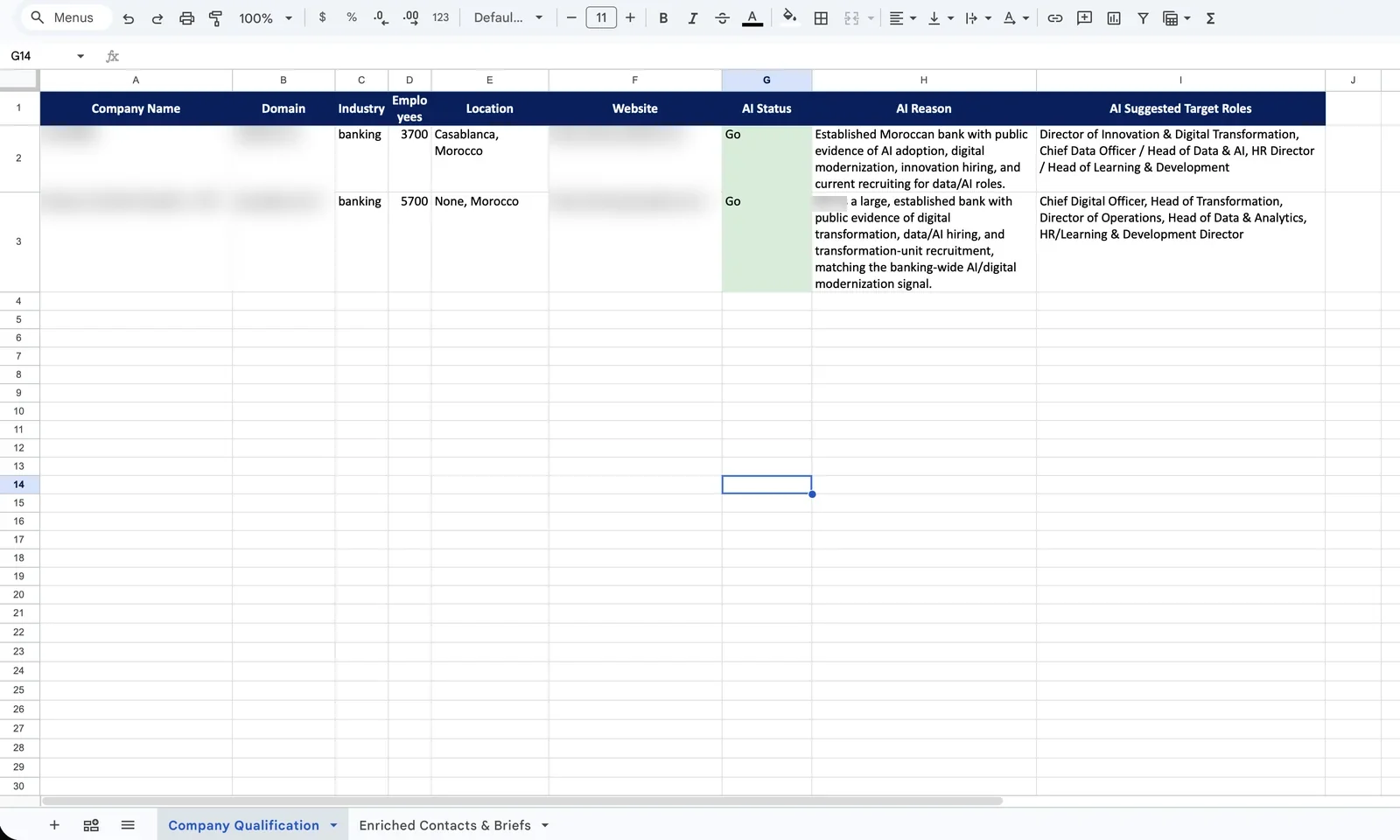
That is GTM engineering. Keeping the data it writes accurate, deduplicated and reportable is RevOps. You can read the full case study here.
Do you need to code to be a GTM engineer?
Not to start. Most first projects are built with no-code tools: a Clay table, a Make or n8n scenario, a few API calls. Code becomes useful when you hit the limits of those tools: custom logic, large data volumes, or connecting a system with no ready-made integration. Google Apps Script, SQL and basic Python cover most of what you will need.
How to become a GTM engineer: a practical path
- Learn one CRM properly. Understand the data model, not just the interface. A certification such as Salesforce Administrator gives that structure.
- Build one pipeline end to end. Pick a real problem, like researching accounts, and automate it from source to CRM.
- Learn APIs and webhooks. Read the API docs of the tools you use and make your first authenticated request.
- Get fluent with one enrichment tool. Clay is the most requested; the concepts carry over to others.
- Measure the outcome. Hours saved, meetings booked, cost per qualified lead. Hiring managers want results, not tool lists.
- Publish your work. A portfolio with two or three case studies, each showing the problem, the system and the result, beats any CV line.
GTM engineer or RevOps: which should you hire first?
- Hire a GTM engineer when your problem is pipeline volume: reps lack enough qualified accounts, research takes too long, or outbound depends on manual work.
- Hire RevOps when your problem is trust: nobody believes the forecast, the CRM is full of duplicates, or every team reports a different number.
- For a small team, one technical RevOps person who can also build is usually the right first hire. Build the pipeline and govern the data in the same head.
FAQ
Is a GTM engineer the same as RevOps? No, but they overlap heavily. Most listed responsibilities appear in both, while the tools and the focus differ: GTM engineers build outbound and enrichment systems, RevOps owns data, process and forecasting.
Do GTM engineers need Clay? It is the most requested tool, named in about two thirds of GTM engineer postings in recent studies, but the skill employers want is building enrichment workflows. The specific tool matters less.
Can a RevOps professional become a GTM engineer? Yes, and it is one of the most natural paths. RevOps people already know the CRM and the data. Adding enrichment, workflow automation and APIs is the main step.
I build and run revenue systems for B2B teams: CRM architecture, enrichment, outbound automation and pipeline reporting. If you are building or fixing a revenue engine, see my work or try my free RevOps tools.