The workaround is the feedback: why your team isn't using the CRM
By Jawad Chafai, RevOps and GTM engineer ·
Every team has a spreadsheet nobody is supposed to use anymore. It isn't the problem. It's the most honest feedback your systems will ever get, if you know how to read it.
You know that Excel file nobody's supposed to use anymore?
The one from 2021 that technically got replaced by "the new system". The one everyone still quietly opens, because the new system doesn't do what they need.
That file is not the problem. That file is a symptom. And most of my best work starts with finding it.
I work in revenue operations for a B2B sales team. Before that I spent years running learner communities, onboarding, retention outreach and events. Those two worlds taught me the same lesson from opposite sides: a system only works if the people inside it are set up to succeed. Not the process on paper. The real one. The messy one. The one that lives in someone's head.
The numbers behind the frustration
If you've ever wondered why sales teams resist new tools, look at how they actually spend their week. Salesforce's own State of Sales research found that reps spend just 28% of their week actually selling (7,775 sales professionals surveyed). Two years later, the next edition found reps still spend 70% of their time on non-selling tasks.
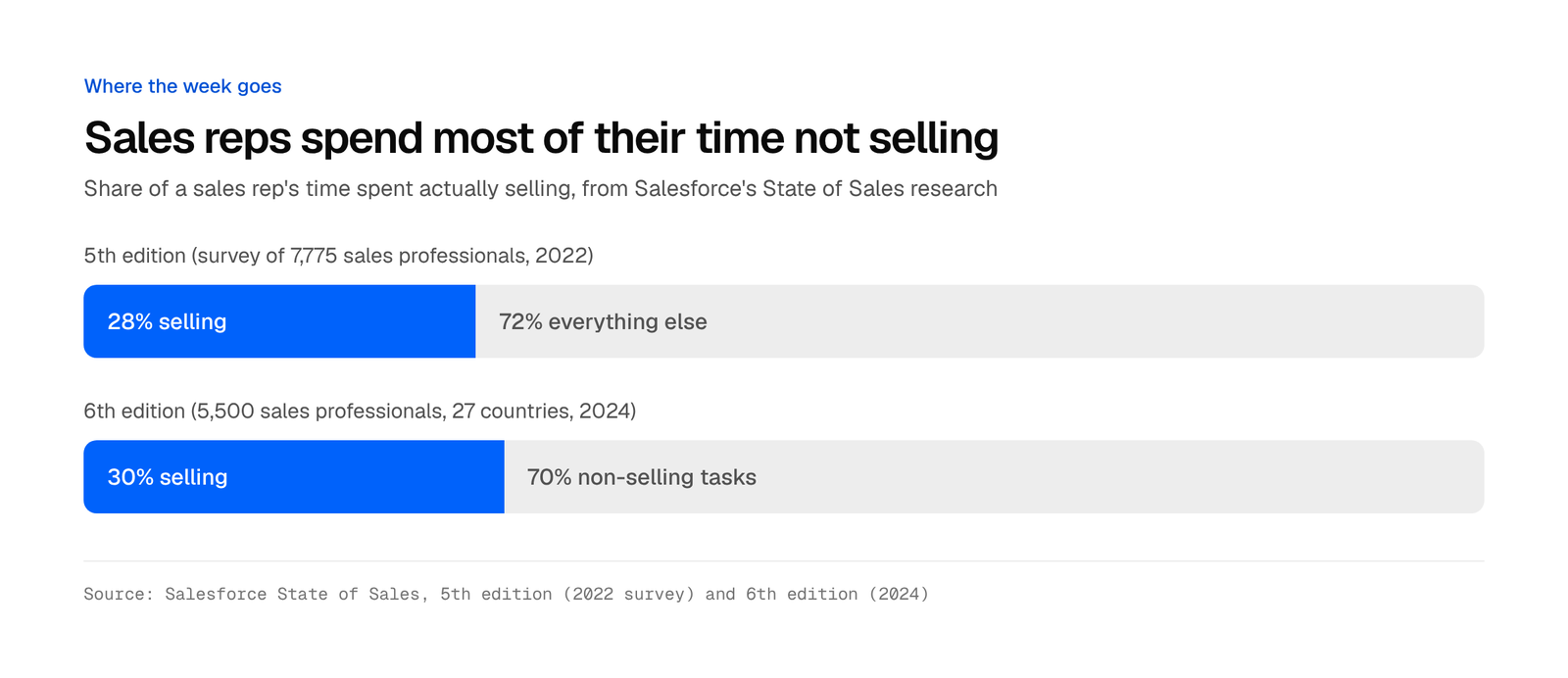
Every field you add to a CRM, every manual status update, every "just log it after the call" comes out of that small slice of selling time. People don't build workarounds because they're lazy. They build them because the official way costs them time they don't have.
And the trust problem compounds it. In the same 2024 research, only 35% of sales professionals completely trust the accuracy of their organization's data. If you don't trust the system, you keep your own copy. That's how shadow spreadsheets are born.

Three signs your process is broken
These are the patterns I look for first. You're probably living with at least one of them.
1. The shadow system. A spreadsheet, a doc or a WhatsApp group that sits outside your official stack, but runs your actual work. It exists because the official system failed the people using it.
2. The human router. One person everyone asks. Not because it's their job, but because they're the only one who knows how things really work. When they go on holiday, things stall. When they leave, chaos follows.
3. The permanent workaround. A "temporary fix" from three years ago that quietly became the standard operating procedure. Nobody questions it. Nobody remembers why it started. Everyone just does it.
The expensive mistake
Most companies try to solve process problems with headcount. The process breaks, so they hire someone to fix it. That person inherits the chaos, burns out trying to hold it together, and gets blamed when it still doesn't work. Then the cycle repeats.
Automation without diagnosis has the same problem. A bad process running ten times faster is still a bad process. It's just more expensive, and harder to undo.
The workaround is the feedback. Most companies just never read it.
How to read what your workarounds are telling you
The method I use has three steps: Find, Fix, Embed.
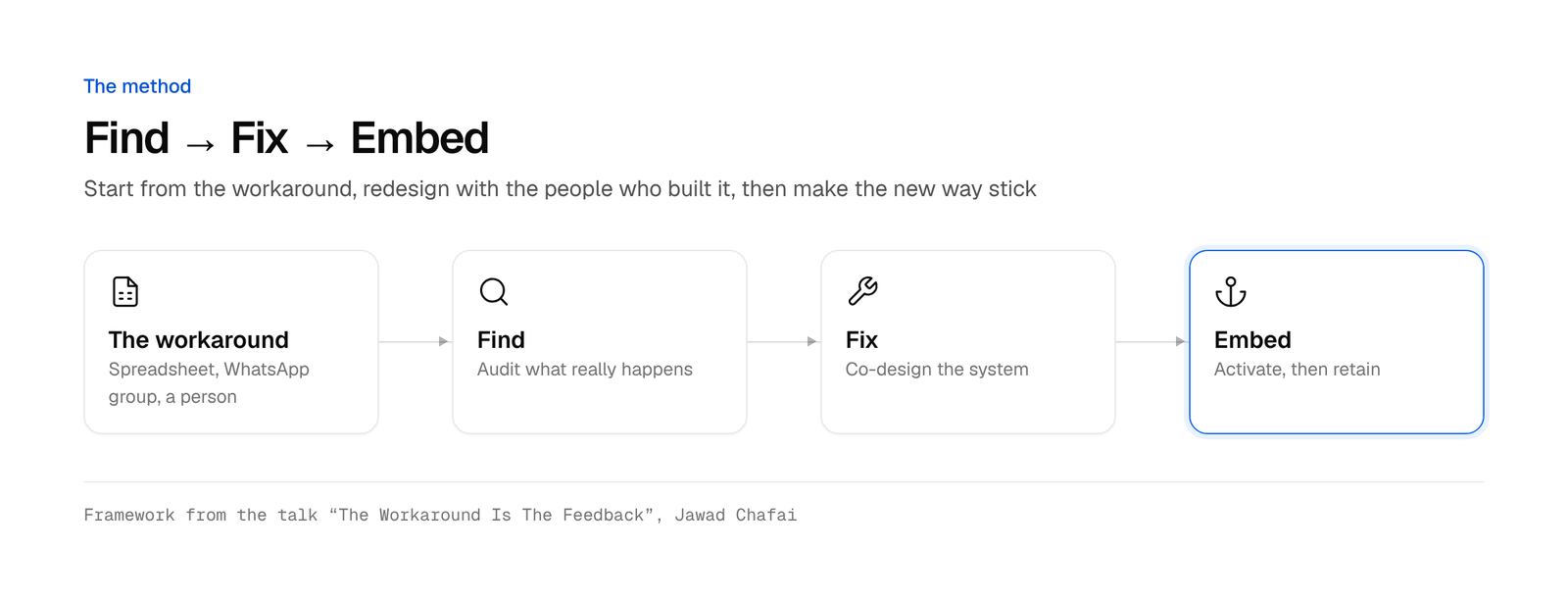
1. Find: locate the real process
Ask people to show you how the work actually happens. Not the diagram. Reality. Watch, and the Excel file, the WhatsApp group or the notebook will appear.
Then ask why it exists, without judging it. "When did you start using this? What problem did it solve?" The answer is a description of exactly where your official system failed.
In my own work, finding usually means digging into data nobody has looked at closely. Tracing payment records once surfaced an anomaly that tied around 28% of revenue to invalid program assignments: a mapping problem between enrolment and payment that no dashboard was showing. In outbound, I noticed our sequencing tool wasn't keeping contacts on the same A/B variant from one step to the next, so the "test" results meant nothing. Neither problem was visible from the official reports. Both were visible from the workarounds people had built around them.
2. Fix: redesign with the people who do the work
Every workaround is a rejected process. Map the original flow next to the workaround, side by side. The difference between them is your redesign roadmap.
The people who built the workaround are your best process designers. They already solved the problem, just unofficially. Build on what they made instead of replacing it.
For the sequencing problem, the fix wasn't a clever setting. It was structure: one sequence per persona and product, 43 in total, under a written sending policy (shared B2B mailboxes only, never personal ones). For duplicated contacts across two outreach tools, the fix was a reconciliation step so the team stopped paying twice to email the same person. Small, boring, documented. That's what makes it last.
3. Embed: activation and retention
This is the part most consultants skip. You find the broken process, you redesign it, you document it beautifully, you train the team. And three months later, everyone is back to the old way.
It fails for predictable reasons: training without context, tools without habits, and change designed for people instead of with them.
Two ideas from community building changed how I approach this:
- Activation is not training. It's the moment someone uses the new process on their own, because it helped them, not because they were told to. Activation is understanding, plus a first successful use, plus confidence.
- Retention is not compliance. It's when the new way becomes the default, and nobody questions it because it simply works. Retention is habit, reinforcement and psychological safety.
In practice that means context-first onboarding instead of manuals, small wins in the first seven days, peer reinforcement instead of policing, and feedback loops that actually close. When I ran activation campaigns for more than 1,100 learners, the biggest lifts didn't come from more reminders. They came from segmenting people by where they were stuck and giving each group one clear next step.
The same applies to a CRM. When we replaced paper sign-in sheets and scattered spreadsheets at our coworking hubs with Pass2Work, the win wasn't the Salesforce objects. It was a QR check-in that was faster than the paper sheet it replaced. People adopted it because it saved them time on day one.
Five things to take with you
- The workaround is the feedback. Every shadow system, quick call and side spreadsheet is your process talking. Learn to listen.
- You don't have a people problem. You have a process problem, and you're trying to solve it with headcount.
- Process maps lie. The happy path is not the real path. Find out how work actually flows before redesigning anything.
- Activation is not training. The only adoption metric that matters is someone succeeding on their own.
- Retention is not compliance. New processes stick when people understand why they exist, not when they're forced to follow them.
If your team has a spreadsheet nobody is supposed to use anymore, I'd love to hear about it. That's usually where the most interesting work starts. You can find more of what I build at chafaijawad.com.